THE LEAF
A blend, not a single tea
Tea masters combine grades and origins to tune aroma, colour, strength and finish.
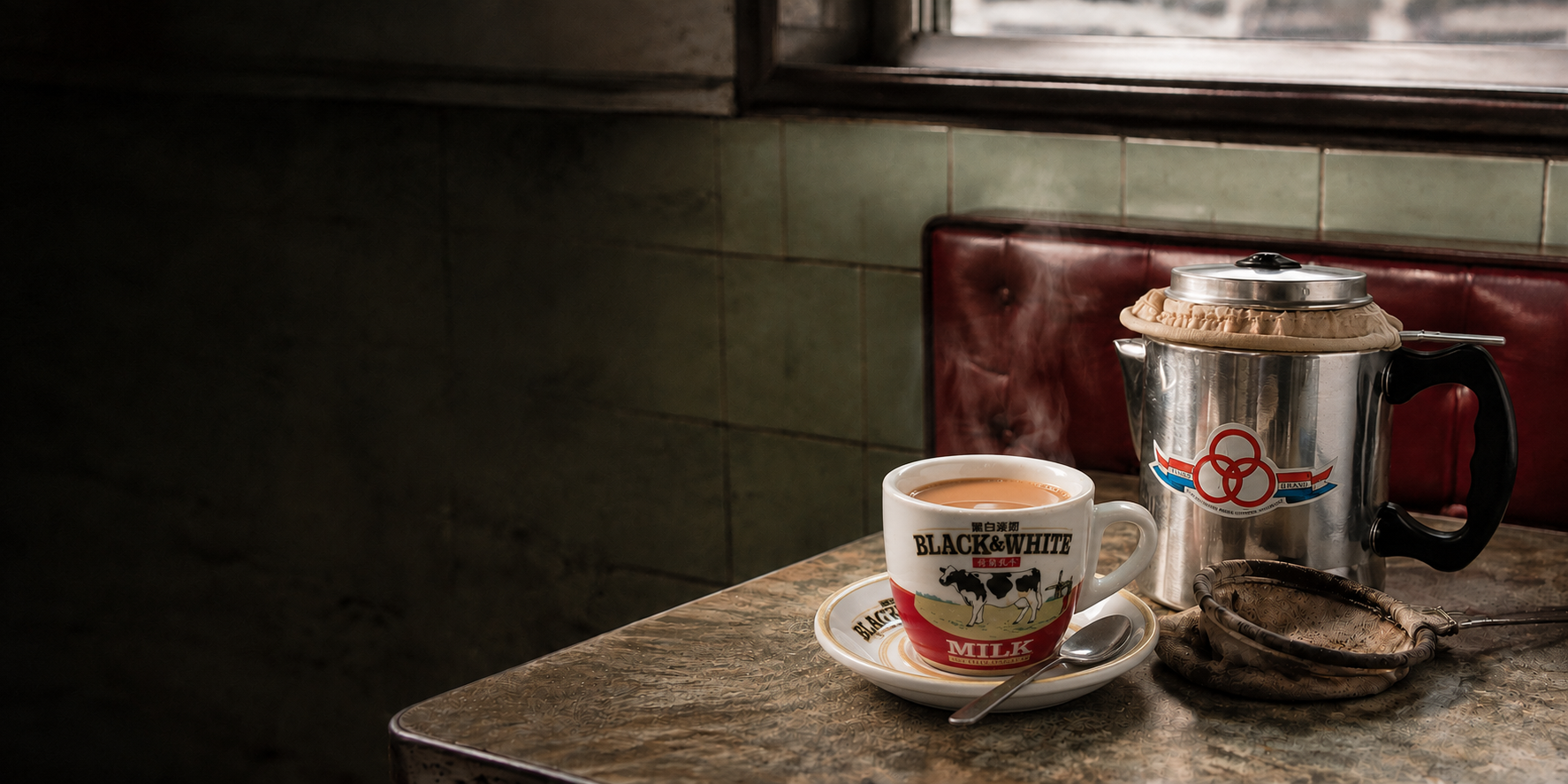
A living Hong Kong craft · 香港非物質文化遺產
A complete field guide to the leaves, the “silk stocking,” the force-pour, the cha chaan teng—and the cup that became a city ritual.
THE ESSENTIALS
The short answer
Hong Kong milk tea starts with an assertive black-tea blend, brewed to a concentrated liquor, repeatedly strained through cloth, then balanced with evaporated milk. The result should be brisk yet smooth, fragrant, full-bodied and unmistakably tea-forward.
THE LEAF
Tea masters combine grades and origins to tune aroma, colour, strength and finish.
THE FILTER
The repeatedly stained cotton bag resembles a stocking. The drink contains no silk.
THE MILK
Its concentrated dairy body stands up to forceful tea without muting it.
ANATOMY OF A CUP
Three systems in balance
A good cup is not judged by darkness alone. Tea supplies the architecture, milk rounds the edges, and technique joins them without flattening either.
Aromatic high notes + malty body + enough fine material for colour and intensity.
Concentrated dairy solids give body and a long, smooth finish.
Fresh water and controlled extraction determine clarity, fragrance and tannin.
Tea must still speak
after milk arrives.
THE CRAFT
A practiced sequence
The official heritage description centres on blending, boiling, infusing and force-pouring. Every shop then develops its own rhythm and sensory benchmarks.
Aroma · colour · backbone
Hong Kong milk tea is usually built from more than one black tea. Tea masters combine grades and origins so one component can lift the aroma while another supplies malt, colour or a lingering finish.
The working bench
Capacity, heat stability and a clean pour.
Holds fine tea while allowing rapid flow.
Makes repeated transfer controlled and consistent.
Keeps the batch active without scorching or stalling.
BREW AT HOME
A repeatable starting point
This is a practical home formula, not an official or universal shop recipe. Use it to learn the variables, then tune by taste.
Hot-liquid safetyUse heatproof vessels, keep pours low and controlled, and never squeeze or grab a hot filter by hand.
YOUR BATCH
Approximate starting quantities. Vessel loss, tea absorption, ice and preferred cup size will change final yield.
Rinse both heatproof vessels and the clean cloth filter with hot water.
Add tea to just-boiled water. Keep at a controlled lively simmer for about 3 minutes.
Lower the heat and infuse for another 3 minutes. Avoid an aggressive, endless boil.
Pour through cloth into the second vessel, then return through the filter once or twice.
Add tea to evaporated milk, sweeten to taste, then adjust tea—not only sugar—if balance is missing.
ORDER LIKE A LOCAL
The counter decoder
Tap a phrase to hear what it changes. House practice varies, so a quick confirmation never hurts.
jit6 naai5 caa4
熱奶茶The clearest way to taste aroma, body and finish.
HERITAGE & CITY
An everyday inheritance
The drink is a record of adaptation: English milk tea, Chinese tea knowledge, imported canned milk and the fast rhythm of the cha chaan teng converged into something locally specific.
English tea-with-milk enters Hong Kong’s food culture.
Cha chaan tengs translate Western-style food and drink into fast, affordable local fare.
Strong blended tea, cloth filtration and evaporated milk mature into a recognisable city style.
The making technique enters Hong Kong’s first Representative List of Intangible Cultural Heritage.
Hongkong Post issues a special stamp set celebrating the making technique.
Recipes evolve, but skill still passes through repetition, sensory judgment and shop practice.
Know the family
These traditions overlap, travel and evolve. The useful differences are technique, dairy, flavour architecture and service—not a contest for authenticity.
| STYLE | TEA BASE | METHOD | DAIRY | SIGNATURE |
|---|---|---|---|---|
| Hong Kong milk tea | Robust black-tea blend | Cloth-filtered; force-poured | Evaporated milk | Brisk, fragrant, satin |
| British milk tea | Black tea, often larger leaf | Steeped once | Fresh milk | Gentler, lighter dairy |
| Teh tarik | Strong black tea / tea dust | Pulled between vessels | Condensed and/or evaporated | Sweet, frothy, aerated |
| Thai iced tea | Black tea, often flavoured | Steeped then chilled | Condensed + evaporated milk | Sweet, aromatic, iced |
| Taiwan milk tea | Black tea or oolong | Steeped; many formats | Fresh milk or creamer | Variable; often with toppings |
TASTE & TROUBLESHOOT
Fix the cup, not the symptom
LIKELY CAUSE
TRY THIS
CHECK YOUR CUP
Four quick questions
Answer all four to reveal your score.
Common questions
No. The nickname refers to the well-used white cloth filter turning tea-brown and resembling a stocking.
You can make a good milk tea, but it will be lighter and less concentrated. Evaporated milk is central to the familiar Hong Kong-style body.
Not quite. Hong Kong technique centres on passing strong tea through a cloth filter and between brewing vessels. Teh tarik is known for pulling the completed sweet milk tea between vessels to aerate and foam it.
No. Tea grades, origins, ratios, extraction rhythm, milk and sweetness vary by shop and tea master. That variation is part of the living craft.
Yes: use a very fine mesh strainer, optionally lined with an unbleached filter. You can learn the flavour balance, though the flow and texture will differ.
Sources & method
Hong Kong Intangible Cultural Heritage OfficeOfficial technique overview and cultural significance.
↗02Hongkong Post / HKSAR Government2017 inscription, nickname explanation and 2023 stamp issue.
↗03Centre for Food Safety2013 study of caffeine in local café-style milk tea.
↗04Chinese Culture Festival / LCSDHong Kong tea culture and the evolution of cha chaan teng milk tea.
↗05“Kamcha King” heritage programmeTea-master variation in blend and brewing method.
↗The home formula and troubleshooting advice are educational starting points developed for this guide; they are not an official heritage recipe or food-service standard.